
In this article
Why one off-plan moment so often turns into an off-plan week
The mindset shift that keeps your habits alive on chaotic days
A 3-step framework to build “if-then” fallback plans, with real-life examples
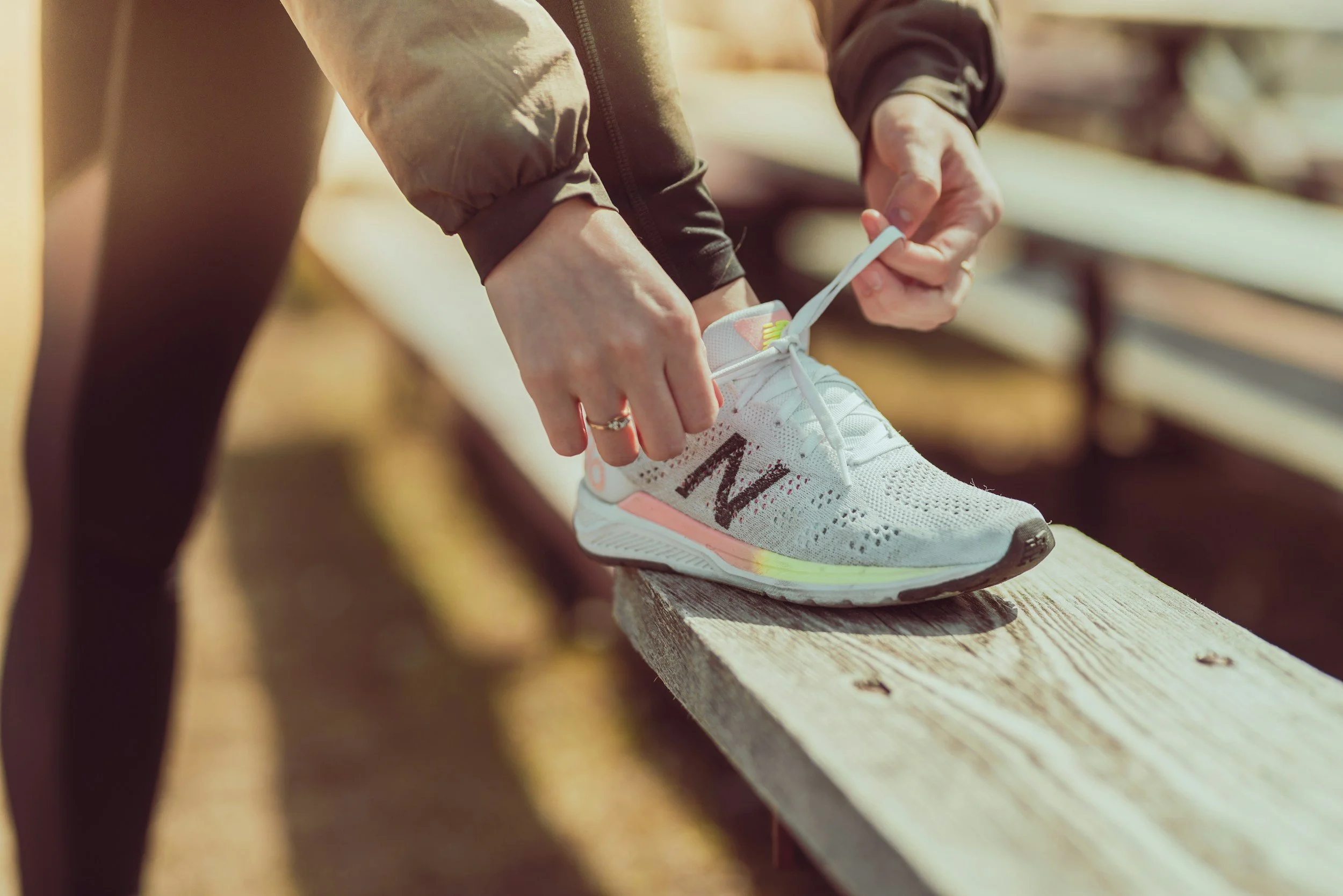
It’s Sunday night. The fridge is stocked, your gym bag is packed by the door, and you’re in bed on time for a full night of sleep. This is the week you get back on track.
Monday and Tuesday go beautifully. You wake up early, you work out, you drink your water.
Then comes Wednesday.
Maybe perimenopause night sweats wrecked your sleep. Maybe your boss dropped a massive deadline on your desk. Maybe your teenager remembered at 4:00 p.m. that she needs a ride home from soccer practice.
You miss your workout, grab takeout instead of cooking that healthy chicken recipe, and a familiar, exasperated voice says: “Well, I already ruined today. Screw it. This week is toast.”
“I’ll start again next Monday.”
If that voice sounds familiar, you’re in very good company. As a health coach who works with women over 40, I hear this story a lot. And I’ve lived it myself.
The “All-or-Nothing” trap
This is All-or-Nothing thinking, and it can feel hard-wired. It comes from the idea that health requires perfection: if we can’t give 100%, then 0% seems like the only logical alternative.
Missed the 60-minute gym session? Skip movement altogether. Ate off-plan at lunch? The rest of the day (or week) is a write-off. Stayed up past your “ideal” bedtime for two episodes of Widow’s Bay? Might as well watch one more.
“All-or-Nothing” thinking is a term from cognitive behavioral therapy (CBT). It describes a mindset that says if you haven’t had complete success, you’re a complete failure. Think of the straight-A student who gets a B on a test and concludes, “Now I am a failure” (Burns, 1980).
This concept comes from the world of CBT, but I’m borrowing it here as coaching shorthand for a mindset I see often around health habit goals.
Why one donut becomes a lost week- the “What-the-Hell” effect
You may already suspect that one missed workout or one unplanned donut can set off a chain reaction. You’re right, and researchers have studied it.
Eating researchers Janet Polivy and Peter Herman gave this pattern a relatable name: the “What-the-Hell” Effect (Polivy & Herman, 1985).
Here is what they described in people who diet strictly. When people break their own food rules, even a little, they often don’t stop there. They feel a surge of guilt and a sense of failure, decide the day is already “ruined,” and think:
What the hell, my diet is already broken. I might as well finish the cake.
The research is more complex than this basic idea, but the notion that a minor slip-up can lead to a slippery slope of poor choices probably resonates.

Why does this happen? According to Stanford University health psychologist Dr. Kelly McGonigal, it isn’t a lack of willpower. When we miss a goal, guilt creates emotional discomfort, and the fastest relief is usually the comfortable option (McGonigal, 2012). In my experience, that would be the couch, the takeout, or the late-night binge-watching.
For women over 40 who are likely carrying the mental load of a career, a family, and perhaps aging parents, there is often simply less room to absorb a hiccup. The All-or-Nothing voice insists that one missed target means abandoning everything else you planned, and maybe even doubling down on doing the opposite.
It isn’t rational, but it is deeply human.
The reframe: “All-or-Something”
All-or-Something means this: when the full plan isn’t possible, you do a smaller version instead of nothing.
Bestselling author, motivational speaker, and podcast host Mel Robbins (The 5 Second Rule, The Let Them Theory) has talked about this approach. On a day that goes sideways, her advice is to shrink the goal. Shrink it, and the habit gets easier to do. Check out the Reel here: https://www.instagram.com/reels/DTSzAqeiXL-/ .
Not enough time for a full-hour workout? Mel’s suggestions include a 15 minute walk and 11 pushups (Robbins 2026). I work with my clients to find anything that gets them moving that they will actually do—a quick run, a 10-15 minute dumbbell routine, a bodyweight circuit, whatever they can and will do in a short period of time.
Here’s why this matters: when you’re building a habit, consistency matters more than intensity.
This isn’t a new idea. James Clear, in his bestselling book Atomic Habits (2018), popularized the notion that the habit-forming effects of small, repeated actions compound over time. He ties in the idea that habits are also a part of identity. So showing up for even a “bad” workout counts, because,
“…it’s not always about what happens during the workout. It’s about being the type of person who doesn’t miss workouts.” (Clear, pp. 201-02).
Say you planned a 60-minute run but only have time and energy for a 10-minute walk. The All-or-Nothing brain says skip it, because 10 minutes doesn’t “count.” You likely won’t even break a sweat, after all.
The All-or-Something brain takes the walk.
Physically, a shorter workout may not deliver the same benefits as the longer planned one. Behaviorally, however, it’s a real win. You just showed your brain that you’re someone who shows up for herself, even when life is chaotic.
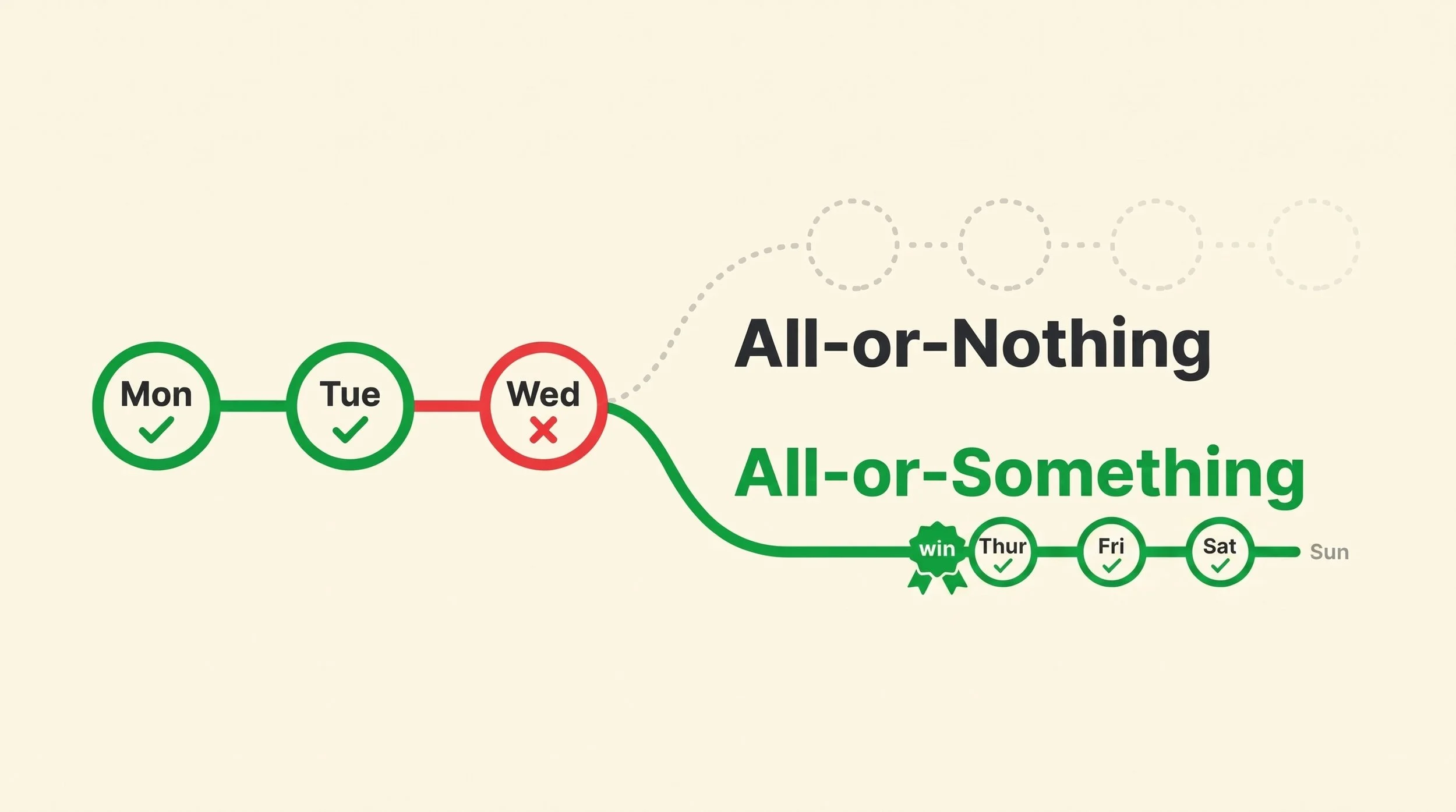
Every time you choose something over nothing, you strengthen the habit and weaken the What-the-Hell spiral.
The method: three steps
So how do you put an All-or-Something mindset into practice? With a repeatable structure.
The approach I use with clients has three steps: Shrink It, Pre-Decide It, and Smooth It.
Step 1: Shrink It
Decide in advance what the smallest acceptable version of each habit looks like: a 10-minute walk, a protein-forward meal assembled (or just heated) in 15 minutes, five minutes of breath work before bed.
Remember Mel Robbins’ advice? The minimum should be small enough that it’s hard to talk yourself out of.
Step 2: Pre-Decide It
Psychologist Peter Gollwitzer’s research on “implementation intentions” explores why so many of us fail to turn good intentions into action. His work shows that people who anticipate obstacles and create specific “if-then” plans are more likely to follow through (Gollwitzer & Sheeran, 2006).
This applies both to creating goals and to anticipating the derailers that get in the way. An implementation intention is a way to pre-decide what you’ll do in the face of distractions and likely obstacles, so you don’t abandon the goal altogether.
The format is simple:
IF [the obstacle], THEN I will [a specific, easy action].
Example: If it’s 6:00 p.m. and I’m too tired to cook, then I will heat the soup I keep in the freezer.
The decision is already made, so you don’t have to make it when you’re feeling depleted. (And for many of us, that depletion hits well before evening.)
This matters because decision fatigue feels very real for many of the women I have coached. If your 60-minute workout window shrinks to 20 minutes and you have to spend 10 of them deciding what to do, doing nothing starts to look very appealing.
Step 3: Smooth It
Smoothing means removing friction and obstacles so the plan is actually easy to carry out.
Habit researcher Wendy Wood speaks to this in her book Good Habits, Bad Habits: The Science of Making Positive Changes That Stick (2019),. She suggests that making a good habit stick involves reducing friction (make the habit easier) and using context cues (time of day, and what’s in your environment that reinforces the habit).
What this means for you: your fallback has to be easy enough for tired, stressed, rushed you.
Once you have a Shrink It and a Pre-Decide It, make sure your backup plan is as easy as you can make it. Check, for example, that:
Your workout clothes are laid out
You have floor space for the shorter workout you planned
Any equipment you need is ready to go
If any of these is missing, you’re less likely to follow through, even if you chose a plan for exactly a day like today, when your workout window shrank.
Putting it together

Here’s how to use Shrink It, Pre-Decide It, and Smooth It across common situations:
Workouts: Shrink the workout to the time you actually have. Pre-Decide by saving two or three short at-home workouts on your phone, with links, that you’ve tried (or at least previewed) and like. Smooth the path by laying out your workout clothes the night before (you had planned to workout, after all) and making sure you have floor space and any equipment (these you do earlier, like when you make this plan).
Healthy dinner, option 1 (takeout): Create a short list of nearby restaurants with healthy (or at least healthy-ish) options, along with the exact items you’ll order, so you’re not wrestling with a menu while hungry. Note which days each restaurant is open and whether they deliver or you need to pick up.
Healthy dinner, option 2 (stock up): Keep your freezer and pantry stocked for a meal that can be on the table in under 15 minutes: frozen veggies, frozen burgers or other minimally processed heat-and-eat proteins, jarred sauces with mostly whole-food ingredients, simple packaged prepared grains or beans.
Stress relief: Bookmark a short calming routine ahead of time in an app you’ve already downloaded, so you’re not hunting for one mid-stress. (I like the Headspace and Happier apps.)
Emergency nutrition: Stash protein bars or bags of nuts in your purse, car, and desk.
Look ahead: Scan your week for potential landmines or unknowns. If the soccer team wins Monday night, then we need a plan for Thursday’s playoff game.
All-or-Something in real life- Examples
These examples are composites with changed names. Think of them as strategies for your back pocket.
Sarah: the shrinking workout window
Sarah is 43. She planned to drive to the gym for her favorite 45-minute strength class at 5:30 p.m. Just as she’s leaving the office, a client calls with a crisis.
By the time Sarah resolves it, she has only 25 minutes before she needs to be home to start dinner, and the gym is a 15-minute drive away. All-or-Nothing Sarah says, “I can’t make the class, so I guess I won’t work out today.”
Sarah’s All-or-Something time-crunch fallback: If I don’t have time to drive to the gym and take my full class, then I will do the 15-minute dumbbell routine I saved on my YouTube app as soon as I walk in my front door.
But what if the problem isn’t time but exhaustion? A streak of poor sleep, hormonal changes, or an emotionally draining day can make even picking up a dumbbell feel impossible. (If fatigue is persistent, that’s worth a conversation with your healthcare provider.) The All-or-Nothing voice says that if you aren’t sweating, it doesn’t count, so just hit the couch.
Sarah’s All-or-Something fatigue fallback: If I’m too physically or mentally drained for a high-intensity workout, then I will do 10 minutes of gentle mobility work, or take a slow walk outside, just to move my body and clear my head.
Michelle: the dinner dilemma
Michelle is 55. She meal-prepped on Sunday, and it worked beautifully on Tuesday. But on Thursday she takes her aging mother to a long doctor’s appointment, then drives her youngest to soccer practice. She walks in the door at 7:00 p.m., utterly exhausted.
Michelle’s All-or-Something low-energy fallback: If I’m too exhausted to cook my planned meal, then I will heat the frozen veggie burgers and toss together the pre-washed bagged salad I keep in the fridge for emergencies.
But what if even the microwave feels like too much? Some nights you simply say, “I am not cooking. Period.” All-or-Nothing Michelle hits the nearest drive-thru.
Michelle’s All-or-Something zero-cooking fallback: If I refuse to step foot in the kitchen, then I will order a grilled chicken and hummus bowl from the local Mediterranean cafe instead of defaulting to a heavy pizza.
And what if she misses the dinner window entirely and finds herself staring at the clock at 8:30 p.m.? All-or-Nothing Michelle either skips eating and wakes up ravenous at 2:00 a.m., or eats a very large meal right before bed and sleeps poorly.
Michelle’s All-or-Something missed-the-window fallback: If it’s past 8:00 p.m. and I haven’t eaten, then I won’t force a full dinner. I will have Greek yogurt with berries or a simple protein shake when I get home, so I’m nourished but can still wind down for sleep.
Tanya: the late-night spiral
Tanya is 42. She committed to being in bed by 10:00 p.m. But after a stressful day, a long, emotional phone call with her sister runs until 11:15. Now she’s wired.
All-or-Nothing Tanya says, “Well, my bedtime is ruined and I’m stressed anyway,” and doom-scrolls until 1:00 a.m.
Tanya’s All-or-Something fallback: If I miss my bedtime and feel too wound up to sleep, then I will set a timer and do five minutes of slow box breathing in the dark. Or I will sit in a dim room with a physical book until I feel calm and sleepy.
If disrupted sleep is a persistent problem, it’s worth discussing with your doctor.
Where to start this week
Chasing the perfect plan isn’t realistic, it isn’t sustainable, and it isn’t effective.
The women who succeed at lasting change aren’t the ones who never stumble. In the face of life’s chaos. They’re the ones who refuse to let one stumble end the story. They pivot. They adapt. They understand that a 10-minute workout is infinitely better than a zero-minute workout, and that flexibility and grace matter for wellbeing, not just wellness.
Look at your upcoming week. Where are the landmines? What is most likely to interrupt your routine? Pick one obstacle today and write down your All-or-Something reframe and your if-then fallback.
Ditch the need for “all,” refuse to accept “nothing,” and watch how powerful “something” can be.
Want help building your own fallback plans?
I’m a health coach, not a physician, dietitian, or licensed therapist. I help women over 40 with lifestyle changes. This article is educational and is not medical or mental health advice. If you’re dealing with persistent sleep problems, menopause-related symptoms, anxiety, depression, overwhelming stress, or concerns about your eating, please talk with your healthcare provider.
Sources
Burns, D. D. (1980). Feeling good: The new mood therapy. William Morrow.
Clear, J. (2018). Atomic habits: An easy & proven way to build good habits & break bad ones. Avery.
Gollwitzer, P. M., & Sheeran, P. (2006). Implementation intentions and goal achievement: A meta-analysis of effects and processes. In M. P. Zanna (Ed.), Advances in experimental social psychology (Vol. 38, pp. 69–119). Elsevier Academic Press. https://doi.org/10.1016/S0065-2601(06)38002-1
McGonigal, K. (2012). The willpower instinct: How self-control works, why it matters, and what you can do to get more of it. Avery.
Polivy, J., & Herman, C. P. (1985). Dieting and binging: A causal analysis. American Psychologist, 40(2), 193–201. https://doi.org/10.1037/0003-066X.40.2.193
Robbins, M. [@melrobbins]. (2026, January 9). The problem isn’t that you “don’t have time.” Most days, you don’t need more time – you need a smaller ask [Video]. Instagram. https://www.instagram.com/reels/DTSzAqeiXL-/
Wood, W. (2019). Good habits, bad habits: The science of making positive changes that stick. Farrar, Straus and Giroux.