
About an 8-minute read

Remember what the holidays felt like when you were a kid? Watching the Macy's Thanksgiving Day Parade. Decorating the tree. Lighting the first candle for Hanukkah. The smell of something baking. Counting down the days with a giddy, can't-sit-still kind of excitement.
Somewhere along the way, many of us traded that wonder for a to-do list, and it's easy to reach January tired, with only a vague memory of the good parts.
This year, what if you put yourself on the list, chose the moments you truly want, and soaked them in, while your healthy habits hum along quietly in the background? You don't need perfection or a January restart. You need a little planning, a little flexibility, and permission to enjoy yourself.
In a hurry? The short version:
Choose your "yes" list first. Pick two or three events, traditions, or experiences you really want, and protect them.
Do about half to three-quarters of your usual workouts, and make them count. Research suggests you can maintain your fitness on far less exercise, as long as the effort stays up.
Steady on ordinary days, joyful on special ones. Stay consistent most days, and enjoy your celebrations fully and guilt-free.
Want everything in one place? Grab my free Savor the Season Planner to map out your Joy Zones, Holiday Events, workouts, and downtime.
Start With What You Actually Want
Most of us build our holiday calendar backward. We say yes to everything and hope there's room left for ourselves. Try flipping it. Before the calendar fills up, take ten minutes and put four things on it, in this order:
1. Your Joy Zones. Two or three events, traditions, or experiences that would make this season feel magical to you, not what everyone expects. Maybe it's an afternoon with no errands, a massage, a girls' night out, a few catch-up calls with long-distance friends, or a night with just you and your college-age kid. Put these on the calendar first, and protect them.
2. Your Holiday Events. Next, add the family schedule: dinners, school plays and concerts, gift exchanges, and invitations. Seeing it all helps you avoid over-scheduling.
3. Your downtime. Schedule it the way you'd schedule a party: a movie night in your pajamas, a long bath, a quiet morning with something warm, a walk to see the lights. Nesting isn't laziness. It's one of the best parts of the season.
4. Your workouts. More on these below.

Say no kindly, so you can say yes fully
Look at your Holiday Events. Does it feel like too many? Every yes to something you don't want is a no to something you do.
Say no to some invitations. Choose the ones that matter most and politely decline the rest.
Set limits on requests for help. "I'd love to help, and I have an hour on Thursday" is a complete answer. You can also ask, "Which one or two things are most urgent?"
Resign as Default Rescuer. If you're always the one who bakes the extra cookies or signs up to volunteer because no one else did, it's okay to stop. Unless the whole event is your responsibility, doing your fair share is plenty.
This year, put yourself on the list.
Protect your sleep
Sleep doesn't go on the calendar, but setting an intention to avoid too many late nights is a smart habit. If you're in perimenopause or menopause, it matters even more. Disrupted sleep and hot flashes or night sweats are common at this stage, and a rough night can make everything feel harder. [1][2]
Keep Your Fitness With Less
Here's some of the best news of the season: you don't have to keep up your usual routine to keep your fitness.
A review by researchers at the U.S. Army Research Institute of Environmental Medicine found that endurance can be maintained for up to about 15 weeks with as few as two sessions a week, or with workouts a third to two-thirds shorter. Strength and muscle can be maintained for months on far less training than it took to build them. The key was keeping the intensity up, meaning the effort and the load. [3]
One caveat: as we age, muscles may need a bit more maintenance, up to two strength sessions a week. [3][4]
The holiday season is only about six weeks, so this is a great fit. Maintaining, not improving, is the goal.
My rule of thumb, based on this research: aim for about 50 to 75 percent of your usual workout time or days, and make what you do count. For example:
Four 45-minute workouts a week become two, or three 30-minute workouts, with the effort kept where it normally is.
Three strength days become two shorter ones.
If you work with a trainer, check with them before changing your programming.

Your "all-or-something" options
When your schedule explodes, lean on an if-then plan you make now. Research on "implementation intentions" shows we follow through more when we decide in advance when and where we'll act. [5] For example: "If I can't get to my boxing class, then I will ______." Some options:
A brisk walk. Wonderful for mood and for soaking in the lights.
One max set of push-ups. Wall, incline, knee, or floor, based on your level.
A short Peloton ride or a 10 to 15 minute home dumbbell video.
A mini circuit for home or a hotel room. For example, five rounds of 5 push-ups, 10 squats, and 15 sit-ups.
Also plan a rest day or two, with no guilt. (I explain the all-or-something approach in more detail here: www.chapter3wellness.com/blog
Steady Days, Joyful Celebrations
So what about food? Keep your ordinary days steady, and let your celebrations be celebrations.
On regular days, eat the way you usually do. Anchor your meals with protein and fiber, especially at breakfast and lunch. It makes it easier to pass up random treats that aren't all that great, so you can fully enjoy the ones that are.
On your celebration days, enjoy them fully. Choose a handful (three to five works well) of Joy Zones and traditional big meals where you'll eat what you want, slowly and happily, with zero guilt.
The guilt-free part isn't a loophole. It's a strategy. Researchers distinguish between rigid control of eating (strict, all-or-nothing rules) and flexible control (a steady approach that allows room for enjoyment).
Flexible control has been associated with less overeating, lower body weight, and better odds of successful weight management. Rigid control has been associated with the opposite. [6] And most people gain only a modest amount over the holidays, often under a pound. [7] Small, steady habits matter more than any single dinner.
Party tips (no carrot sticks required)
Let's retire the advice to eat a plain chicken breast before the party so you won't eat anything there, skipping meals earlier in the day to “save up” calories, and the idea of "earning" your food with workouts. Try these instead:
Fuel up early. Breakfast and lunch are easiest to control. Get protein and fiber in, and you'll arrive ready to enjoy the party.
Curate your plate. Survey the spread first. Start with the protein you like best, then choose the carbs and fats that are truly worth it to you. If Aunt Betty is watching for you to sample her signature dish, take a polite serving and compliment her. Whether you eat it is up to you.
Mind the alcohol and sleep connection. The biggest cost of overdoing it often isn't the calories. It's tomorrow. Alcohol may help you fall asleep faster, but it tends to disrupt your sleep later in the night and can reduce REM sleep. [8] A short night of sleep can also increase hunger and cravings the next day. [9] Alternate each drink with a glass of water to pace yourself and stay hydrated.
Try the "first bite" rule. In my experience, the most pleasure from a rich food comes in the first few bites. Take the dessert, sit down, and eat it slowly. When the pleasure fades, give yourself permission to stop.
Handling the food pushers
You never have to over-explain or defend your choices, and you get to decide how much of your health story to share. A few easy options:
"Everything looks amazing. I'm starting with these."
"Don't worry, I'm having my fair share!"
"I've found I feel better when I avoid [gluten/sugar/dairy], so I'm going to try some of the other treats tonight." (Use this one only if it's true.)
If You're on a GLP-1 Medication: Enjoy the Season Your Way
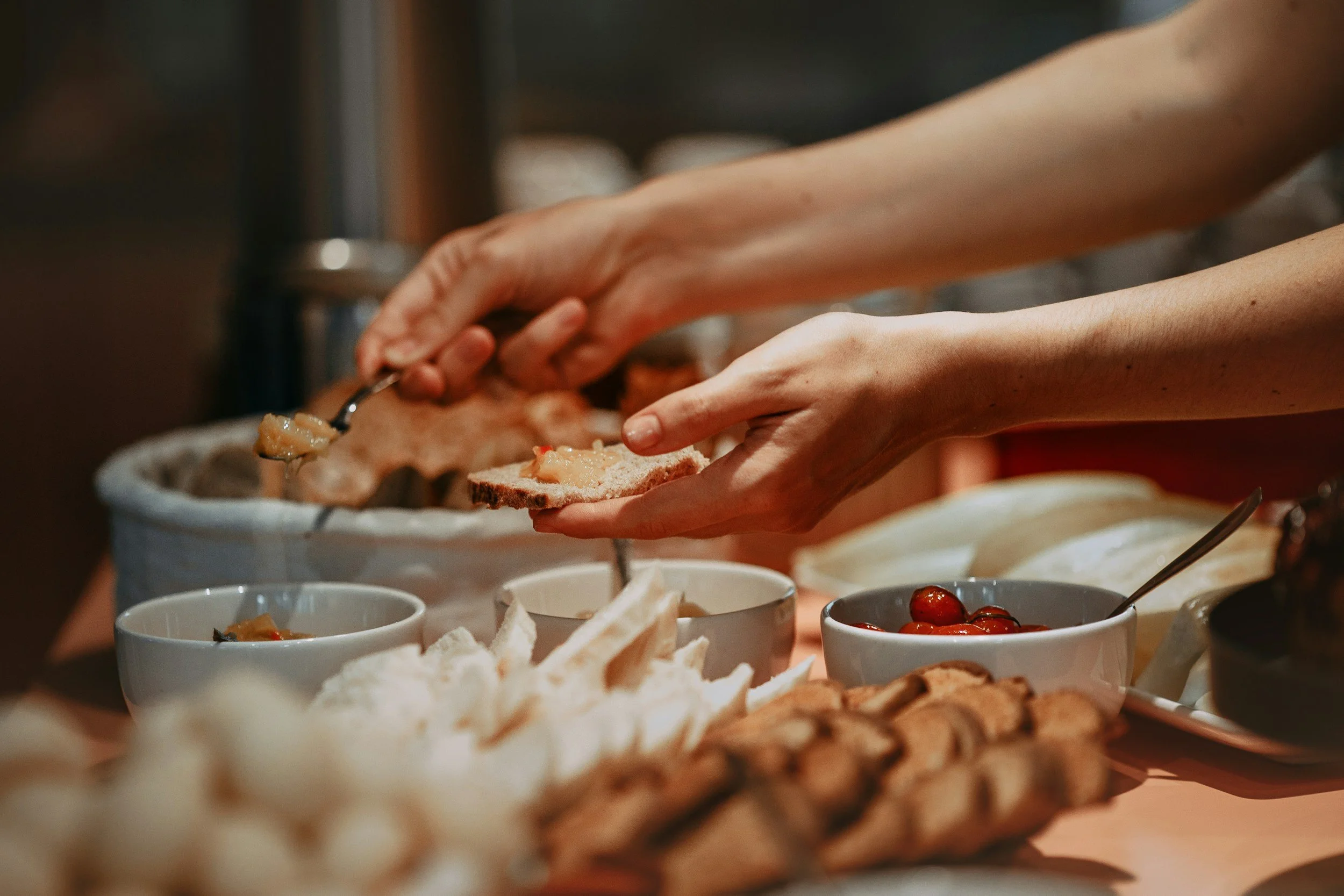
If you've started a GLP-1, the holidays may feel different this year. Your appetite may be smaller, and your tastes and tolerance for rich foods may have shifted. That doesn't mean you'll miss out. Choose quality over quantity, and you may find that a few bites of your very favorite things can be completely satisfying.
Four leading medical organizations (the American College of Lifestyle Medicine, the American Society for Nutrition, the Obesity Medicine Association, and The Obesity Society) issued a joint advisory on supporting people on GLP-1s. It highlights nutrient-dense foods with enough protein, resistance training to help preserve muscle and bone, and managing digestive side effects and changes in food preferences. [10] Here's how that can look at a holiday table:
Start with protein. With a smaller appetite, every bite counts. Fill part of your plate with protein first (if available), then add your must-have favorites in small portions.
Go slow and stop at comfortable. Leftovers are one of the best parts of the holidays.
Sip fluids all day, including on celebration days.
Notice how rich foods and alcohol feel. GLP-1 medications slow digestion, so heavy or high-fat foods can stay in your stomach longer and may cause cramps, bloating, or nausea. [11] If you notice discomfort, scale back and let your prescriber know.
Keep some strength training on your calendar. Protecting muscle is a priority on a GLP-1. [10]
It's also worth a quick check-in with your prescriber or a registered dietitian before the season gets busy. Good questions include how much protein is right for you, how to handle hydration and alcohol, and what to do if side effects flare around a big meal. For a general guide, see this article from UC Davis Health. [11]
One more thing: everyone may have an opinion about your plate this year. Whether you tell friends and family that you're on a GLP-1 is 100 percent up to you. You can use one of the responses above, change the subject, or share that the medication has changed how you eat.
Remember What You're Celebrating
When things get busy, take a few quiet minutes to ask yourself what you most want to remember about this season. Maybe it's the sound of a house full of people. Maybe it's an unhurried morning with the lights on and nowhere to be.
The holidays aren't something to survive. They're something to enjoy, with your health and your joy right there beside you. Choose your yeses, protect your energy, move a little, eat well most days, and celebrate fully on the days that count.

Want help putting it all together? My free Savor the Season Planner gives you a simple place to map out your Joy Zones, Holiday Events, workouts, and downtime.
This article is educational and is not medical or mental health advice. I'm a health coach, not a physician, dietitian, or licensed therapist. I help women over 40 with lifestyle changes. If you're dealing with persistent sleep problems, menopause symptoms, anxiety, overwhelming stress, questions about medications (including GLP-1s), or concerns about your eating, please talk with your healthcare provider or mental health provider.
Sources
Kravitz, H. M., & Joffe, H. (2011). Sleep during the perimenopause: A SWAN story. Obstetrics and Gynecology Clinics of North America, 38(3), 567–586.
Kravitz, H. M., Zhao, X., Bromberger, J. T., Gold, E. B., Hall, M. H., Matthews, K. A., & Sowers, M. R. (2008). Sleep disturbance during the menopausal transition in a multi-ethnic community sample of women. Sleep, 31(7), 979–990.
Spiering, B. A., Mujika, I., Sharp, M. A., & Foulis, S. A. (2021). Maintaining physical performance: The minimal dose of exercise needed to preserve endurance and strength over time. Journal of Strength and Conditioning Research, 35(5), 1449–1458. https://doi.org/10.1519/JSC.0000000000003964
Bickel, C. S., Cross, J. M., & Bamman, M. M. (2011). Exercise dosing to retain resistance training adaptations in young and older adults. Medicine & Science in Sports & Exercise, 43(7), 1177–1187. https://doi.org/10.1249/MSS.0b013e318207c15d
Gollwitzer, P. M., & Sheeran, P. (2006). Implementation intentions and goal achievement: A meta-analysis of effects and processes. Advances in Experimental Social Psychology, 38, 69–119.
Westenhoefer, J., Stunkard, A. J., & Pudel, V. (1999). Validation of the flexible and rigid control dimensions of dietary restraint. International Journal of Eating Disorders, 26(1), 53–64.
Yanovski, J. A., Yanovski, S. Z., Sovik, K. N., Nguyen, T. T., O'Neil, P. M., & Sebring, N. G. (2000). A prospective study of holiday weight gain. New England Journal of Medicine, 342(12), 861–867. https://doi.org/10.1056/NEJM200003233421206
Ebrahim, I. O., Shapiro, C. M., Williams, A. J., & Fenwick, P. B. (2013). Alcohol and sleep I: Effects on normal sleep. Alcoholism: Clinical and Experimental Research, 37(4), 539–549. https://doi.org/10.1111/acer.12006
Hanlon, E. C., Tasali, E., Leproult, R., Stuhr, K. L., Doncheck, E., de Wit, H., Hillard, C. J., & Van Cauter, E. (2016). Sleep restriction enhances the daily rhythm of circulating levels of endocannabinoid 2-arachidonoylglycerol. Sleep, 39(3), 653–664.
American College of Lifestyle Medicine, American Society for Nutrition, Obesity Medicine Association, & The Obesity Society. (2025). Nutritional priorities to support GLP-1 therapy for obesity: A joint advisory. The American Journal of Clinical Nutrition, 122, 344–367.
UC Davis Health. (2026). How to enjoy holiday meals while taking a GLP-1 weight loss medication. Cultivating Health. https://health.ucdavis.edu/blog/cultivating-health/how-to-enjoy-holiday-meals-while-taking-a-glp-1-weight-loss-medication/2026/10